How to Choose the Right Giant Welding Equipment for Your Projects?
Choosing the right equipment for Giant Welding is critical for success in many projects. According to a recent report by the International Welding Institute, over 70% of welding failures result from improper equipment selection. Specialized equipment enhances efficiency and ensures material integrity.
Industry expert Dr. Mark Thompson stated, "The right welding equipment transforms the job from a challenge into a seamless operation." This highlights the importance of informed choices in equipment selection. Current trends indicate a growing demand for high-performance welding machines. Companies need to stay updated with the latest advancements in Giant Welding technology.
While many believe all tools are fundamentally the same, the nuances can create significant impacts. A poorly chosen machine can lead to time loss and costly rework. Therefore, assessing project needs and equipment specifications is essential. This careful analysis can lead to better productivity and reduced errors. Emphasizing these aspects ensures a more reliable outcome.
Understanding Your Project Requirements for Giant Welding Equipment
When selecting the right giant welding equipment, understanding your project requirements is crucial. Assess the nature of your project. Are you dealing with heavy metals? Does the work involve thick sections or intricate designs? The size and type of materials will dictate the equipment needed.
Tips: Consider the duty cycle of the equipment. A higher duty cycle allows for longer continuous operation. Match the equipment to your skill level. Some machines have a learning curve that may not suit beginners.
Think about the location of your work. Will you operate indoors or outdoors? Conditions like temperature and humidity can affect welding quality. Imagine needing to weld in a windy area; a stable setup becomes essential.
Tips: Make sure the machine is portable if necessary. You may need to move it frequently. Assess the power supply requirements, too. Certain projects demand a stronger power source. Choosing incorrectly can lead to frustrating delays.
Evaluating Different Types of Giant Welding Equipment Available
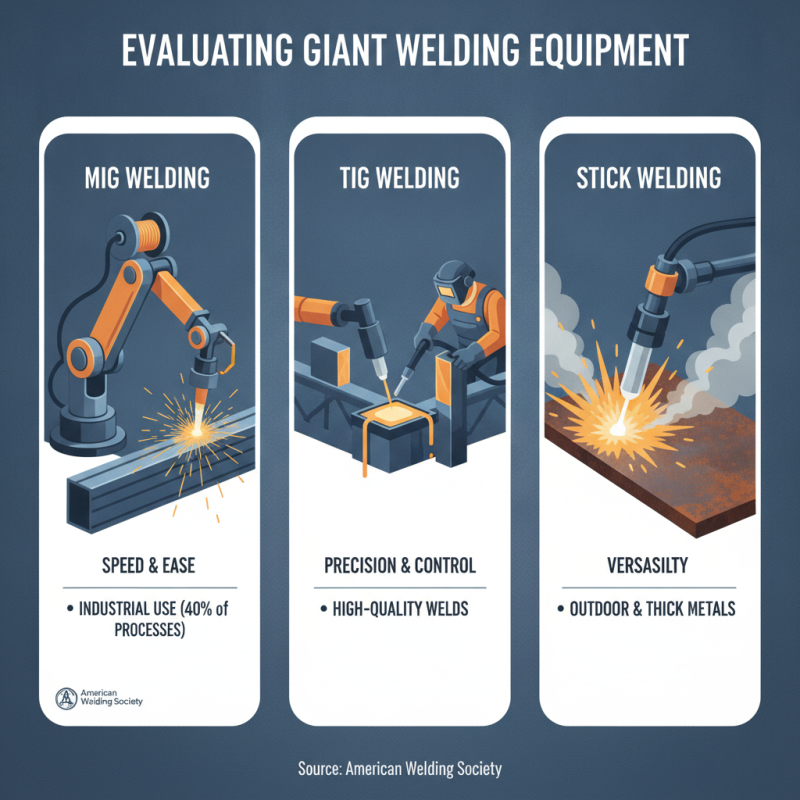
When selecting giant welding equipment for projects, understanding different types is crucial. Various options exist, such as MIG, TIG, and stick welding machines. Each type offers distinct benefits. For instance, MIG welding is known for speed and ease, making it common in industrial settings. According to the American Welding Society, MIG welding accounts for nearly 40% of all welding processes used in the industry.
In contrast, TIG welding provides high precision and control. It is preferred for intricate work and thinner materials. Data from welding technology reports indicate that TIG can yield stronger joints but requires greater skill. Stick welding, another popular method, is durable and portable. It shows superior performance in outdoor environments, which is why it remains a staple for construction projects.
As you evaluate different welding equipment, consider your project requirements. Will you be working indoors or outdoors? Is portability a factor? Reflecting on these aspects will lead to better choices. Research indicates that improper equipment selection can lead to increased costs and project delays. Understanding the nuances of these welding methods is essential for successful outcomes.
Key Features to Consider When Selecting Welding Equipment
Choosing the right welding equipment is crucial for the success of your projects. When selecting giant welding equipment, consider key features that can impact your work quality and efficiency. For instance, the American Welding Society reports that improper equipment selection can lead to a 20% decrease in productivity.
Pay attention to the weld type and thickness you will be working with. Different projects require specific electrodes and welding processes. MIG welding is great for thin materials, while TIG is better for precise work. These choices depend highly on the material and design specifications.
**Tip:** Research the materials you'll be working with. Assess their conductivity, melting point, and application requirements.
Another important feature is the power supply. According to industry reports, a reliable power source can enhance performance by up to 30%. Make sure the equipment can handle the voltage and amperage needed for your projects.
**Tip:** Always check the duty cycle of the equipment. A higher duty cycle means less downtime during jobs.
Lastly, user comfort and safety should not be overlooked. Ergonomically designed equipment can significantly reduce operator fatigue. Review operator feedback and safety ratings of the equipment before making a decision.
Budgeting for Giant Welding Equipment: Cost vs. Value Analysis
When budgeting for giant welding equipment, understanding the balance of cost versus value is essential. Recent studies reveal that companies often underestimate maintenance costs, which can account for up to 30% of total equipment expenditures over time. A sound investment in a high-quality welder may have a higher upfront cost but can lead to savings in the long run. Reliable equipment minimizes downtime, ultimately increasing productivity.
Research from industry reports indicates that the average lifespan of well-maintained welding tools is around 10-15 years. This extends to the cost-efficiency of the equipment, as a durable model may save businesses thousands of dollars in repairs and replacements. However, many operators skip a thorough cost analysis and settle for cheaper options that yield low performance.
Additionally, the shift towards specialized equipment can affect overall budget decisions. Specialized welding machines, while initially pricier, often provide superior results and efficiency. It's crucial to consider not only the acquisition cost but also the value they bring to your projects. Investing in training for operators can also enhance the equipment’s effectiveness, ensuring projects meet quality standards. Balancing these factors is key to making informed decisions.
How to Choose the Right Giant Welding Equipment for Your Projects? - Budgeting for Giant Welding Equipment: Cost vs. Value Analysis
| Equipment Type |
Average Cost ($) |
Value Rating (1-5) |
Best Use Case |
| MIG Welder |
800 |
4 |
General-purpose welding |
| TIG Welder |
1200 |
5 |
Precision work and thin material |
| Stick Welder |
600 |
3 |
Outdoor welding and thick materials |
| Multi-Process Welder |
1500 |
5 |
Versatile applications |
| Plasma Cutter |
900 |
4 |
Metal cutting with precision |
Maintenance and Support for Your Giant Welding Equipment Choice
When it comes to selecting giant welding equipment, maintaining that equipment is crucial for optimal performance. Regular maintenance can extend the life of your tools, thereby minimizing costly replacements. Data from an industry report shows that preventative maintenance can reduce equipment downtime by up to 30%. Consistent checks on your welding machines ensure they operate efficiently and safely, providing quality output.
Tip: Schedule regular inspections. Check for wear and tear, and ensure parts are clean. This proactive approach aids in identifying issues before they escalate.
Support is equally important. Establishing a relationship with a reliable service provider can ease maintenance concerns. Their expertise can help troubleshoot problems quickly. According to research, timely support can decrease repair costs significantly. Investing in a capable support network pays off long-term.
Tip: Seek out support resources. Utilize training programs and user manuals to enhance your understanding. Proper knowledge makes a difference.
Remember, neglecting maintenance leads to more substantial issues down the line. Make informed choices about upkeep and support to keep your welding projects running smoothly.