Top 5 Best Core Welding Wire Options for Superior Welding Results?
In the welding industry, the choice of materials significantly impacts the quality of results. Core welding wire is a crucial component that can enhance the welding process. According to the American Welding Society, the right selection directly affects penetration, fusion, and overall weld performance.
Moreover, data shows that using quality core welding wire can reduce defects by up to 30%. This reduction leads to more reliable and durable welds. However, not all core welding wires are created equal. Each offers distinct properties that cater to different applications. Factors like alloy composition, coating, and wire diameter must be considered.
Choosing the best core welding wire is vital for achieving superior welding results. It requires careful evaluation of specific project needs and equipment compatibility. In this article, we will explore the top five core welding wire options that promise to deliver exceptional performance in various welding scenarios.

Types of Core Welding Wires for Various Applications
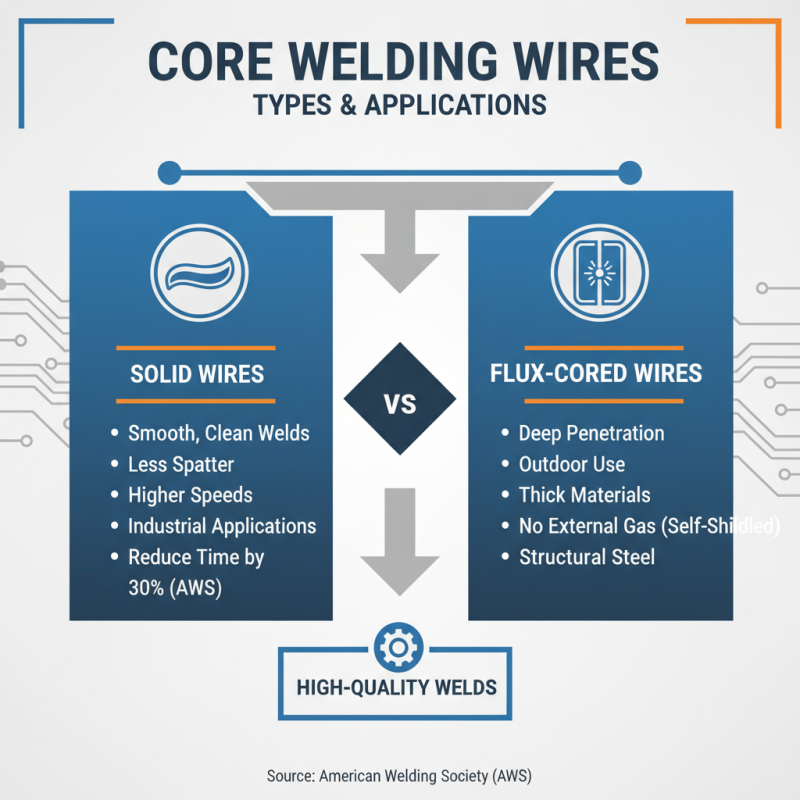
Core welding wires play a crucial role in achieving high-quality welds across various applications. Understanding the types of core welding wires is essential for selecting the right one. For instance, solid wires are ideal for applications requiring smooth, clean welds. These wires generally exhibit less splatter and can operate at higher speeds. According to the American Welding Society, these wires help reduce welding time by up to 30%, particularly in industrial applications.
On the other hand, metal-cored wires combine a metal core with a flux coating. This design enhances arc stability and increases deposition rates. Data from the National Institute for Occupational Safety and Health indicates that using metal-cored wires can improve productivity by delivering up to 50% more weld metal than standard solid wires. However, they can also generate more fumes, requiring adequate ventilation in the workspace.
Flux-cored wires offer versatility for different environments. They can be used indoors and outdoors, even in windy conditions. Yet, they produce more slag and may require additional cleanup work. While flux-cored wires are beneficial, they often lead to inconsistencies in weld appearance, prompting the need for skilled operators. Evaluating these options is important to balance efficiency with quality in welding projects.
Factors to Consider When Choosing Core Welding Wire
When choosing core welding wire, several factors play a crucial role.
Material composition is key. Different types of wires offer unique benefits based on the metal being welded.
For instance, high-carbon steel wires often provide better strength and wear resistance.
The American Welding Society (AWS) indicates that using the correct wire can improve
tensile strength by up to 20%.
Welders should also consider the diameter of the wire. Thicker wires generally produce stronger welds but may require higher amperage.
In contrast, thinner wires are suitable for more delicate applications. According to industry reports, a
1.0 mm diameter wire can enhance control in smaller projects, which is essential for intricate works.
Another critical aspect is the shielding gas compatibility. Not all wires perform well with every gas type.
Specific combinations can significantly affect the arc stability and overall weld quality. Misalignment here can lead to
increased porosity or poor penetration. Research has shown that approximately
15% of weld defects stem from improper gas usage.
In a field that demands precision, ensuring the right match of wire and gas is non-negotiable.
Top 5 Core Welding Wire Options for High-Quality Results
Choosing the right core welding wire is critical for achieving high-quality results. The material should match your project requirements, whether you're working with steel, aluminum, or other alloys. Quality core welding wires effectively reduce spatter and improve arc stability. A dependable wire lowers your chances of defects.
Look for wires with better efficiency in transfer and deposition rates. Pay attention to the diameter and coating. These features can significantly impact weld performance. Not all options will perform equally in different conditions. Consider the environment where you'll be welding. Factors like wind and humidity can affect the weld's consistency.
Experience plays a significant role in identifying the best welding wire for your needs. Even with extensive research, you may find that some wires don't meet your expectations. It's important to test several options to see which works best for you. Remember, not every wire will guarantee perfect results. Learning from each welding experience can lead to improvements over time.
Comparative Analysis of Popular Core Welding Wire Brands
When selecting core welding wire, a comparative analysis of popular brands provides valuable insights. According to the American Welding Society, wire selection plays a crucial role in achieving the desired weld quality. Core wires often vary in chemical composition and physical properties, impacting the overall strength and appearance of the weld.
For instance, certain wires excel in high-speed applications but may produce more spatter. Conversely, some brands focus on low-temperature applications to enhance impact toughness. A recent industry report indicated that approximately 40% of welders prefer aluminum-silicon alloys for their fluidity, yet user feedback often highlights a tendency for these wires to require more careful temperature control.
Moreover, the choice of core wire significantly affects defect rates. Research shows that improper wire can lead to increased porosity or undercutting. While many brands offer reliable products, issues like inconsistent feed rates remain a common concern. This challenges users to find a balance between performance and practical usability. Thus, exploring different welding wires may reveal strengths and weaknesses across options, prompting reflection on user experiences and technical outcomes.
Top 5 Best Core Welding Wire Options for Superior Welding Results
Tips for Optimal Usage of Core Welding Wire in Projects
When using core welding wire, ensure you select the right type for your project. Different wires cater to specific materials and techniques. Be attentive to the wire's composition and shielding properties. This choice can influence your weld's strength and appearance significantly. Each welding challenge may require a unique solution, so don’t hesitate to experiment with various options.
Proper setup is crucial for optimal results. Before beginning, check your welding machine settings. Adjust voltage and wire feed speed accordingly. Inadequate settings can lead to defects like porosity or uneven welds. Ensure the workpiece is clean and free of contaminants. This mundane detail can make or break a project.
During welding, maintain a steady hand and consistent angle. Variations can create inconsistent bead profiles. Take breaks if fatigue sets in. Tiredness can lead to mistakes and poor welding quality. Continuously evaluate the weld as you work. If problems arise, reflect on your technique and adjust your approach. Each project is a learning opportunity.
Top 5 Best Core Welding Wire Options for Superior Welding Results
| Wire Type |
Diameter (mm) |
Filler Material |
Recommended Usage |
Key Benefits |
| E71T-1 |
0.8 |
Mild Steel |
General Purpose |
Good all-position welding |
| E71T-GS |
0.9 |
Mild Steel |
Outdoor Welding |
Wind resistance and versatility |
| E71T-11 |
1.0 |
Mild Steel |
Heavy-Duty Jobs |
Higher deposition rate |
| E60C-1 |
0.7 |
Carbon Steel |
Structural Welding |
Excellent toughness |
| E71T-8 |
1.2 |
High Strength Steel |
Fabrication Work |
Reduced spatter and smooth finish |